internationales_alt
Short-Term Teaching at the University of Strasbourg
1 November 2022
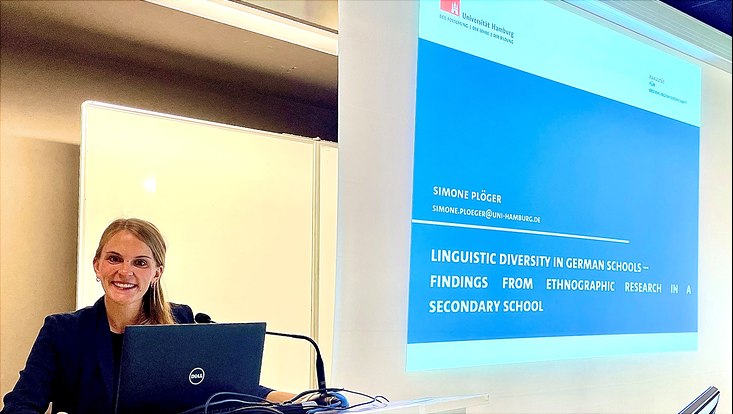
Photo: UHH/Plöger
The International Office talks to Dr. des. Simone Plöger, research associate in Intercultural and International Comparative Education. Just recently, Plöger completed a short-term teaching stint at the University of Strasbourg’s education institute in France. The contact arose at the Internationalization of Teacher Education conference this past spring.
Simone Plöger focuses on social inequality, discrimination, and diversity in school education. She also researches migration-based multilingualism, language education against the backdrop of current migration, and schooling new migrant children. She is a member of the research group DivER—Diversity in Education Research and the project Diversity Contexts in Teacher Education (DiCoT).
International Office: How did the short-term teaching job at the University of Strasbourg come about?
Simone Plöger: During my studies, I completed an Erasmus semester in Strasbourg and I have maintained a strong connection to the city ever since. The idea for a short teaching stint at the University of Strasbourg and the contacts that ultimately made it possible, however, go back to the networking conference that took place at the Faculty of Education at the beginning of the year. There, I met Kaitlin Balthasar (formerly Plachy), with whom I stayed in contact after the conference. In May, I was already invited to Strasbourg to give a talk on linguistic diversity in German schools and findings from ethnographic research in secondary and primary schools and during that stay, I got the idea for doing a longer stay as a teacher.
What did you do during your stay?
The structure of teacher training studies is different from ours in that students do not study a foreign language as a teaching subject but simply do a foreign language seminar. During my stay, I led practical work and discussions in several English and German-language seminars for master’s students. The seminars were structured around language and content. For example, in the German-language seminars, I led discussions on the topic of integration in Germany and in a research-based lecture on linguistic diversity I drew upon data from my dissertation. Because students in the English-language seminars also look, for example, at cultural and linguistic diversity, my practical course, titled My Cultural Background (that we also use in the DiCoT preparatory seminars) fit perfectly.
What do you do in this practical course?
This course helps us to question national understanding of culture; against the backdrop of one’s own culture, we show that “culture” has many different facets. For example, culture is shaped by educational paths, socioeconomic background, and family traditions.
How will the cooperation continue?
Both I and my colleagues at the University of Strasbourg are very interested in expanding upon our cooperation in research and teaching, for example, with a visit from Strasbourg.
Note: Short teaching periods can be conducted at the faculty’s Erasmus partner universities and are funded by the Erasmus program. More information