• Zur Metanavigation
  • Zur Hauptnavigation
  • Zur Suche
  • Zum Inhalt
  • Zur Subnavigation
  • Zum Seitenfuß
  • University of Hamburg
  • For journalists
  • Staff Service Portal0
  • STiNE
https://www.kus.uni-hamburg.de/aktuelles.json?recentnews=true
  • Institutions and target groups
    • Einrichtungen
      • Faculties

        • Faculty of Law
        • Faculty of Business, Economics and Social Sciences
        • Faculty of Medicine
        • Faculty of Education
        • Faculty of Humanities
        • Faculty of Mathematics, Informatics and Natural Sciences
        • Faculty of Psychology and Human Movement Science
        • University of Hamburg Business School
      • Services

        • Study Information Net STiNE
        • Surfmail
        • Exchange
        • Staff Service Portal
        • Learning Platforms
        • Katalogplus – Catalogue of Hamburg Libraries
        • SharePoint
      • Student facilities and services

        • Campus Center
        • Career Center
        • PIASTA
        • AStA (student council)
        • University Sports
        • University Music
        • Family Office
        • University Language Center
        • General Languages
        • Office of Affairs for Students with Disabilities or Chronic Diseases
        • Departmental libraries
        • Healthy Campus
      • Further facilities and services

        • The Cluster of Excellence CLICCS
        • The Cluster of Excellence CUI
        • The Cluster of Excellence Quantum Universe
        • The Cluster of Excellence Understanding Written Artefacts
        • Hamburg Research Academy
        • Pier Plus
        • Hamburg Center for University Teaching and Learning (HUL)
        • Hub for Crossdisciplinary Learning (HCL)
        • CEN
        • Museums and collections
        • University Archives (in German)
        • Regional Computing Center (RRZ)
        • University Administration
        • Knowledge Exchange Agency
        • The Unikontor Shop (in German)
    • Target groups

      • Prospective students
      • Students
      • International prospective students
      • Young researchers
      • Researchers
      • Instructors
      • Staff
      • Prospective continuing education students
      • Alumni
      • Journalists
      • Refugees (in German only)
    Close
  • Language
    • English
    • Deutsch
  • /en/sitemap.json
University of Hamburg - to research, to teach, to educate and form, to homepage

Fakultät für Erziehungswissenschaft

Facultyof Education
  • About the Faculty
    • News
    • Public Events
    • The history of the faculty
    • Office of the dean
    • Faculty Staff
  • Studies
    • Degree programs in education
    • Doctoral studies
  • Research
    • Research Center LiDS
    • Faculty research areas
    • Thematic areas
    • Knowledge exchange
    • Research Topics
    • Research funding
  • Institutions
    • Department of General, Intercultural and International Comparative Education as well as Educational Psychology (EW1)
    • Department of Primary and Secondary Education, Social Pedagogy as well as Special Needs Education (EW2)
    • Department of Vocational Education and Life-Long Learning (EW3)
    • Department of Languages and Aesthetic Disciplines Education (EW4)
    • Department of Social Sciences, Mathematics and Natural Sciences Education (EW5)
    • Academy of World Religions at Universität Hamburg
    • DivER - Diversity in Education Research
    • Graduate School
    • destination not available
    • Academic office (StuP)
  • Services
    • destination not available
    • Digital Teaching
    • Digital Research
    • Center for Empirical Research Methods
    • Resource Center (Elementary Education, English Language Education)
    • InkluSoB (Inklusive Schule ohne Barrieren)
    • Diagnostics Center
  • Internationalisation
    • News
    • Students
    • Staff
    • Internationalisation at the Faculty
    • Dept. of Internationalisation

Photo: UHH/Roehl

  1. UHH
  2. Fakultät für Erziehungswissenschaft
  3. Institutions
  4. Department of Social Sciences, Mathematics and Natural Sciences Education (EW5)
  5. Didactics of teaching science and social studies in primary schools
  6. Academics

Academics

Group of students talking

Photo: Brooke Cagle (unsplash)

Didactics of "Sachunterricht"

Bachelorʼs and masterʼs degree components

Do not hesitate to contact us if you have questions. Find our email addresses in the menu under “Contacts.”

The bachelor’s and master’s degree components in teaching science and social studies in primary schools

Alongside German and mathematics, teaching science and social studies in primary schools (Sachunterricht) is one of the 3 core subjects of primary education. Teaching science and social studies in primary schools is what is known as an “integration subject” that consists of 5 different perspectives: the historical, social scientific, geographic, natural scientific, and technical perspectives. The curriculum covers all aspects of didactics of teaching science and social studies in primary schools as a subject and how to teach it.

Focus of Universität Hamburg’s curricula

One particular focus of the Universität Hamburg curricula is philosophizing with children as a teaching principle in teaching science and social studies in primary schools, which we understand as a means of integrating various perspectives. This has nothing to do with Kant or Descartes but rather with children independently philosophizing about questions related to their lives and experiences: Can dogs think? How did Earth come to exist? Should we always tell the truth? Do humans belong to nature?

Another focus is research-based learning, which is both a teaching method and higher education teaching approach imparted in the core internship. Research-based learning takes children’s questions as a starting point and offers learning arrangements that enable children to build up knowledge and methodological skills independently by actively engaging with the phenomena. Using research-based learning as an educational approach in seminar work starts with students’ questions, which are examined within the context of their own empirical analyses in conjunction with practical experiences and theoretical reflections.

Learning with and via digital media is also a fixed component of the Hamburg curricula, in which working with tablets in teaching science and social studies in primary schools is being specifically tested.

Furthermore, education for sustainable development, extracurricular learning, and outdoor education are concepts that are theoretically grounded and also tested in practice in their studies.

From area of study to subject

Until now, didactics of teaching science and social studies in primary schools has been treated as an area of study rather than as a distinct subject in Hamburg. As part of the general reform of teacher training, teaching science and social studies in primary schools will constitute a separate subject in Hamburg as of Winter Semester 2020/21. Training within the former teaching science and social studies in primary schools area of study will continue in parallel for a few more semesters before being discontinued. Below, you will find degree programs that are valid for you, depending on when you began your studies.

Structure of studies when starting before Winter Semester 2020/21

NB: This structure applies to your studies only if you began before Winter Semester 2020/21!

Prior to the beginning of Winter Semester 20202/21 and within the scope of the applicable bachelor’s and master’s degree programs, teaching science and social studies in primary schools constituted a required elective module in the bachelor’s degree component educational science for teacher training in primary and lower secondary education I and for teacher training in special needs education.

Teacher training in primary and lower secondary education I is studied over 10 semesters; the teaching science and social studies in primary schools module, over 2 semesters.

Teaching science and social studies in primary schools is 1 of 7 optional areas of study. The teaching science and social studies in primary schools module (“Lernbereich Sachunterricht”), which is worth 12 ECTS credits, consists of 3 courses and comprises 7 credit hours per week:

  • an introductory course on didactics of teaching science and social studies in primary schools (2 ECTS credits)
  • an advanced course (3 ECTS credits)
  • an advanced course with a practical element (4 ECTS credits + 3 ECTS credits for the module final examination).

In addition to the teaching science and social studies in primary schools module, teaching science and social studies in primary schools is also offered in the bachelor’s degree program as part of the integrated teaching placement.

In the master’s degree program, teaching science and social studies in primary schools can be chosen as part of the core internship.

The subjects can be chosen freely; studying one of the subjects related to teaching science and social studies in primary schools is not a prerequisite for training in the area of study.

Structure of studies when starting in Winter Semester 2020/21

  • The new degree component in teaching science and social studies in primary schools

Info-Flyer new degree component in teaching science and social studies in primary schools

Within the scope of the teacher training in primary education and the teacher training in special needs education degree programs (primary education), which start in Winter Semester 2020/21, teaching science and social studies in primary schools can be selected as a third subject alongside the subjects German and mathematics.

Both teacher training degree programs will be studied over 10 semesters (6 semesters for the bachelor’s degree program and 4 semesters for the master’s programs). Teaching science and social studies in primary schools as a subject is offered in both the bachelor’s and master’s degree programs.

Teaching science and social studies in primary schools comprises subject-specific academic and teacher training. As part of the subject-specific academic training, students study all subjects related to teaching science and social studies in primary schools (biology, chemistry, physics, history, geography, social sciences, and technology/informatics) equally, totaling 32 ECTS credits (27 ECTS credits for the bachelor’s and 5 ECTS credits for the master’s). The subject-specific teacher training part is worth 20 ECTS credits (12 ECTS credits for the bachelor’s and 8 ECTS credits for the master’s).

Teaching science and social studies in primary schools can be chosen as an advanced subject in the master’s degree program and is worth an additional 15 ECTS credits.

  • The bachelor’s degree component in teaching science and social studies in primary schools

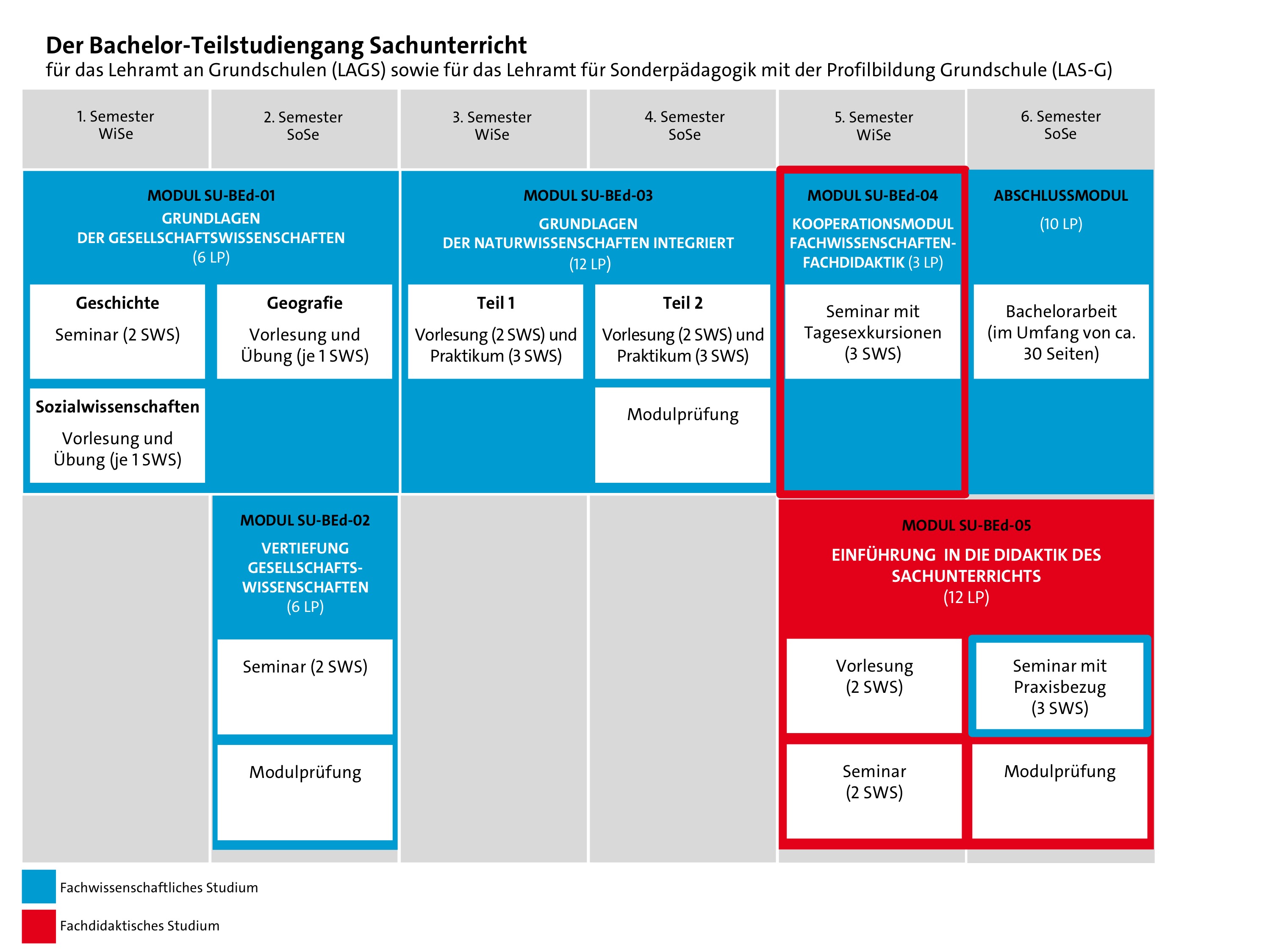
The bachelor’s degree component teaching science and social studies in primary schools consists of required subject and required elective areas. The subject-specific academic part comprises 27 ECTS credits.

Module SU-BEd-01: introductory module on social sciences (6 ECTS credits)

Module SU-BEd-02: advanced module on social sciences (required elective, 6 ECTS credits)

Module SU-BEd-03: introductory module on natural sciences, integrated (12 ECTS credits)

Module SU-BEd-04:  cooperation module on academic disciplines and subject-specific teacher training (3 ECTS credits)

Optional: final module bachelor’s thesis (10 ECTS credits)

The introductory module on didactics of teaching science and social studies in primary schools (SU-BEd-05) consists of 3 required courses worth 12 ECTS credits in total.

  • Lecture (2 ECTS credits)
  • Seminar (4 ECTS credits)
  • Seminar with practical element (4 ECTS credits)
  • Module examination (2 ECTS credits)

Enlarge graphic.

In the bachelor’s degree program, teaching science and social studies in primary schools is also offered as part of the integrated teaching placement.

  • The master’s degree component in teaching science and social studies in primary schools

The subject-specific master’s degree component in teaching science and social studies in primary schools comprises 5 ECTS credits and an optional advanced course.

In the teacher training master’s degree component, teaching science and social studies in primary schools is worth 8 ECTS credits. The advanced teaching science and social studies in primary schools module consists of 2 required courses worth 8 ECTS credits in total.

Optional:       core internship (4 ECTS credits)

Optional:       final module master’s thesis (20 ECTS credits)

Components of technology/informatics are planned for the advanced subject teaching science and social studies in primary schools (15 ECTS credits).

Cooperation

Teaching science and social studies in primary schools training in Hamburg takes place in close cooperation with primary schools.

Cooperation project: Lernwerkstatt Sachunterricht

The Lernwerkstatt Sachunterricht (teaching science and social studies in primary schools learning workshop) cooperation project links teacher training at Universität Hamburg to school development projects and working in primary schools by meaningfully dovetailing theory and practice. Grundschule Hoheluft and Schule Rellinger Straße in Hamburg-Eimsbüttel are cooperation partners.

At both schools, there is a specially equipped teaching science and social studies in primary schools learning workshop that facilitates cooperation.

In the Lernwerkstatt Sachunterricht project, primary school teachers work with students and lecturers from Universität Hamburg within context of concrete teaching science and social studies in primary schools projects. Learning arrangements and projects are planned and prepared in practice-based seminars at Universität Hamburg and then trialed in school classes before being evaluated with the teaching staff.

Examination regulations and subject-specific provisions (FSBs)

For further information on your degree program and qualification obtained, read the respective examination regulations and the subject-specific provisions for your degree program:

Commencement of studies before Winter Semester 2020/21

  • Examination regulations for degree component in teaching science and social studies in primary schools (bachelor’s)
  • Examination regulations for degree component in teaching science and social studies in primary schools (master’s)

Commencement of studies from Winter Semester 2020/21

  • Examination regulations for degree component in teaching science and social studies in primary schools (bachelor’s)
  • Examination regulations for degree component in teaching science and social studies in primary schools (master’s)
  • Subject-specific provisions (FSBs) for degree component in teaching science and social studies in primary schools (bachelor’s)
  • Subject-specific provisions (FSBs) for degree component in teaching science and social studies in primary schools (master’s)
  • Institutions

  • Department of General, Intercultural and International Comparative Education as well as Educational Psychology (EW1)
  • Department of Primary and Secondary Education, Social Pedagogy as well as Special Needs Education (EW2)
  • Department of Vocational Education and Life-Long Learning (EW3)
  • Department of Languages and Aesthetic Disciplines Education (EW4)
  • Department of Social Sciences, Mathematics and Natural Sciences Education (EW5)
    • Mathematics and Introductory Mathematics Education
    • Biology Education
    • Mathematics Education
    • Chemistry Education
    • Geography Education
    • History Education
    • Computer Science Education
    • Philosophy Education
    • Physics Education
    • Didactics of teaching science and social studies in primary schools
      • Research
      • Academics
        • Transfer
        • Contacts
      • Social Studies Education (Politics, Sociology, Economy, Law)
      • Religious Education
    • Academy of World Religions at Universität Hamburg
    • DivER - Diversity in Education Research
    • Graduate School
    • Martha Muchow Library
    • Academic office (StuP)

    Last update: 10 August 2020

    • Feedback
    • Legal notice
    • Privacy statement
    • Accessibility
    • Site map

    University of Hamburg

    Innovating and Cooperating for a Sustainable Future in a Digital Age

    • Follow us on Instagram.
    • Follow us on Facebook.
    • Connect with us on LinkedIn.
    • Follow us on Mastodon.
    • Follow us on Bluesky.
    • Subscribe to our channel on YouTube.
      • Studies
      • Prospective students
      • Continuing education
      • Research
      • Teaching at UHH
      • Doctoral studies
      • Job opportunities
      • Knowledge exchange
      • University
      • Excellence
      • Faculties
      • Alumni
      • Contact
      • Campus Navigator
      • UHHApp
      • Emergencies, safety and security
      • Antidiscrimination
    Go to family-friendly higher education institution audit
    Go to internationalisation re-audit
    Go to the Sustainability Audit page
    Go to Diversity Audit
    Go to System accreditation

    © 2026 University of Hamburg. All rights reserved